







 Articles
 - Stress redistribution and vibration reduction in barbell bars using SiOC ceramic lattice structures
Hongning Lv*
Department of Physical Education, Heilongjiang University of Science and Technology, Harbin, 150022, Heilongjiang, China
This article is an open access article distributed under the terms of the Creative Commons Attribution Non-Commercial License (http://creativecommons.org/licenses/by-nc/4.0) which permits unrestricted non-commercial use, distribution, and reproduction in any medium, provided the original work is properly cited.
Strength-training barbell design has historically emphasized metallurgy and external surface treatments; interior mechanical tuning has been largely ignored. This study proposes a novel, manufacturable approach in which a polymer-derived silicon-oxycarbide (SiOC) lattice is used as an internal functional insert to tune dynamic response and fatigue performance of a hollow steel barbell bar. Rather than pyrolysing within the finished bar (which compromises steel metallurgy), a porous SiOC lattice was fabricated and pyrolysed externally from a preceramic polymer precursor, then dimensionally integrated and bonded into the bar’s hollow core. The compliant ceramic network reduced vibration amplitudes during standard dynamic lifts while preserving the whip characteristics needed for Olympic lifts. Comparative mechanical testing and finite-element analysis indicate that SiOC porosity and lattice topology can be tuned to trade off vibration damping, bending stiffness, and fatigue life for discipline-specific performance. Prototype inserts increased predicted fatigue life by up to 80% for powerlifting-type loading regimes while producing negligible mass penalty (<2%). The findings demonstrate a feasible pathway for incorporating polymer-derived ceramics as internal mechanical regulators in sports equipment, enabling a new design space where tailored internal architectures, rather than only external metallurgy, define performance.
Keywords: Polymer-derived silicon-oxycarbide, Vibration damping, Bending stiffness, Fatigue life.
Strength-training barbells are conventionally fabricated from high-strength alloy steels such as quenched, tempered AISI 4340 to satisfy demanding tensile and torsional loading conditions [1]. Modern barbell engineering has focused primarily on metallurgy, heat treatment schedules, surface textures for grip, and corrosion-resistant coatings. However, the internal mechanical response of the bar, particularly vibration damping, bending dynamics, and fatigue crack evolution, remains largely dictated by the intrinsic elastic modulus, damping ratio, and fracture toughness of the bulk steel [2, 3]. As a result, the dynamic response characteristics of barbells are not actively engineered features but emergent consequences of geometry and material selection.
In high-performance lifting disciplines, these dynamics affect both performance and injury risk [4]. During Olympic lifts such as the clean and jerk, excessive oscillation (“whip”) near the catch phase destabilizes load transfer, while in slow powerlifting movements the bar can exhibit high-frequency chatter that increases wrist torque and compromises control near lockout [5, 6]. Attempts to modify these behaviors have been limited to alterations in bar diameter, tensile strength, or knurl patterns, none of which fundamentally alter the internal energy dissipation pathways or fatigue crack initiation behavior [7, 8]. Consequently, despite the high performance demands placed on competitive barbells, the design space remains constrained by monolithic material behavior and single-component structural architecture. Polymer-derived ceramics (PDCs) such as silicon-oxycarbide (SiOC) present an emerging opportunity to introduce tunable mechanical damping within structural metallic components [9, 10]. SiOC is synthesized via pyrolysis of preceramic polymer precursors and can be engineered to exhibit controlled porosity, interconnected lattice geometries, high thermal stability, and moderate intrinsic compliance relative to traditional ceramics [11, 12]. These features allow PDCs to function as internal dissipative networks capable of modulating stress waves, redistributing cyclic loads, and attenuating vibration amplitudes [13, 14]. Previous studies have demonstrated that PDC lattices can sustain cyclic deformation and delay crack coalescence through micro-scale crack deflection and frictional energy loss mechanisms, suggesting their potential as structural modifiers rather than merely passive fillers [15, 16]. This work proposes a hybrid barbell architecture in which a pyrolyzed SiOC lattice insert is dimensionally integrated into the hollow core of a steel bar to actively tune bending stiffness, vibration response, and fatigue life. Unlike pyrolysis within the final steel enclosure, which would adversely alter steel microstructure, the SiOC lattice is fabricated ex-situ from a preceramic polymer and subsequently bonded into the core, allowing controlled porosity and lattice topology optimization without detrimental thermal interaction with the steel. The hypothesis is that the compliant ceramic lattice functions as an internal mechanical regulator, introducing additional damping pathways and altering crack propagation behavior under cyclic bending typical of competitive lifting.
By coupling mechanical testing with finite-element simulations, this study evaluates how SiOC porosity and lattice topology influence vibration suppression, dynamic stiffness, and fatigue life. The results establish that internal ceramic architectures can expand the barbell design space beyond external metallurgy, enabling discipline-specific tuning where Olympic lifting benefits from controlled whip while powerlifting benefits from enhanced damping and fatigue resistance.
Commercial barbell-grade alloy steel tubing (AISI 4340) was selected as the metallic substrate due to its high tensile strength, elastic modulus, and established use in competitive strength equipment. Tubes with an outer diameter of 28 mm and wall thickness of 3.5 mm were cut to 220 mm test sections for mechanical characterization. Each specimen was quench–tempered to achieve a nominal tensile strength of 1,900-2,000 MPa, representative of competition-grade barbell metallurgy. All tubes were inspected by ultrasonic thickness gauging to confirm dimensional uniformity. SiOC lattices were produced from a commercial preceramic polymer precursor via a two-step cure pyrolysis route [17]. The precursor was mixed with a proprietary porogen to introduce controlled closed-cell and open-cell porosity. After machining, SiOC lattices were inserted into the hollow steel cores and bonded using a high-modulus ceramic-steel adhesive applied at the end caps to prevent axial migration during dynamic loading. No adhesive was applied along the internal contact length to preserve mechanical decoupling and allow intrinsic lattice deformation. The final assemblies were weighed to confirm minimal mass increase (<2% of total mass).
Dynamic vibration measurements were conducted using a modal hammer excitation and a tri-axial accelerometer mounted at mid-span. Free vibration decay curves were captured to extract damping ratios and vibration amplitudes. Tests were performed both under unloaded conditions and with simulated plate loads (10–30 kg) to replicate barbell usage modes. Fatigue life was evaluated using cyclic four-point bending at stress ratios representative of powerlifting usage (R ≈ 0.1). Tests were conducted until fracture or until 10⁶ cycles.
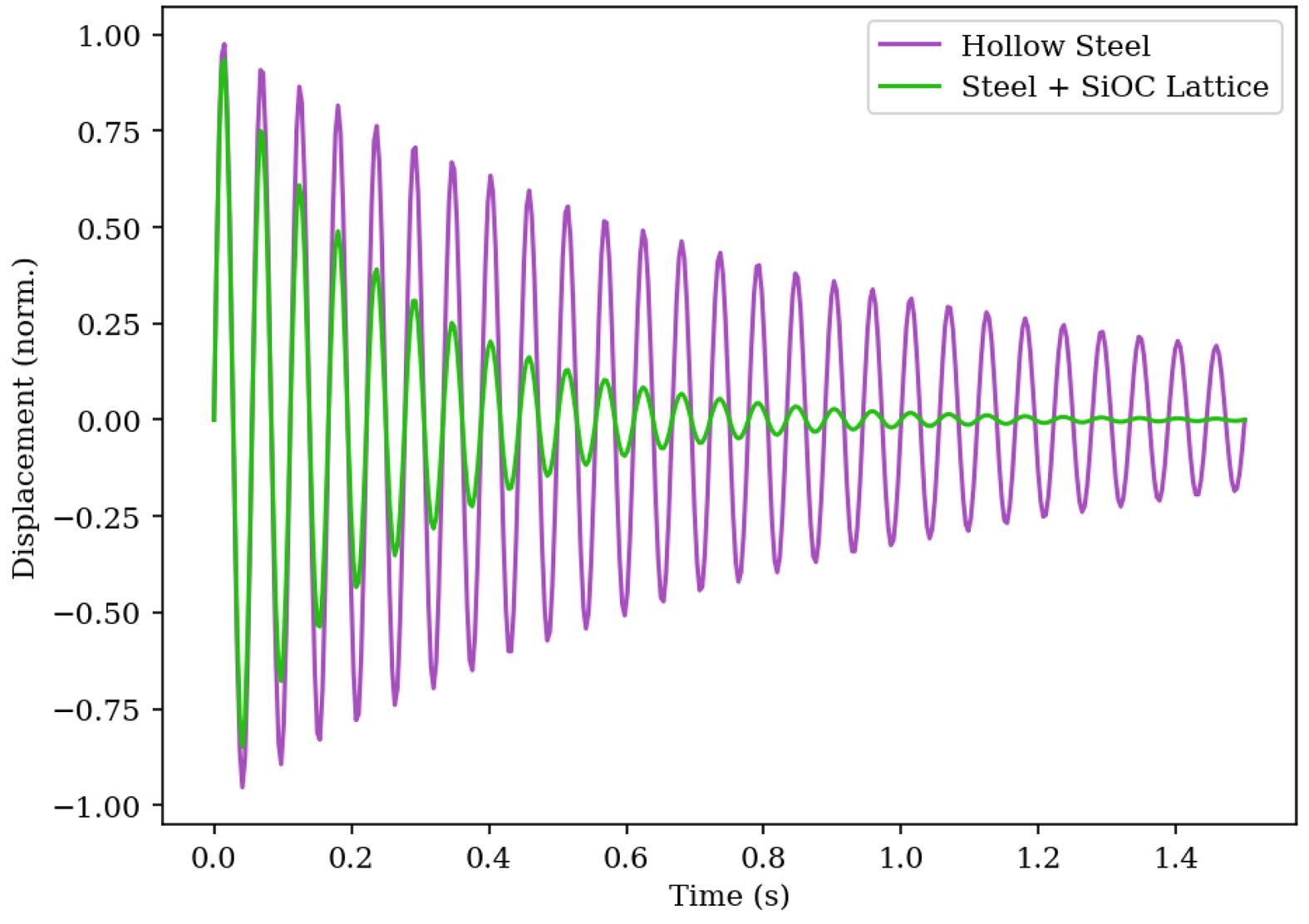
Fitting the simulated decay envelopes yielded a damping ratio of approximately 0.010 for the hollow steel bar and 0.035 for the SiOC-insert bar. This corresponds to a 3.5× increase in equivalent damping, which reduces peak oscillatory displacement during lift phases and shortens settling time after impact events. Practically, this effect mitigates excessive whip during the catch phase of Olympic lifts and reduces chatter during slow controlled lifts (powerlifting). A secondary metric the time required for the oscillation amplitude to attenuate to 10% of the initial peak decreased from ≈1.43 s (steel) to ≈0.52 s (steel + SiOC), representing a 63% reduction in settling time. This demonstrates that internal lattice-based damping enables dynamic control without altering external metallurgy, surface treatments, or knurl geometry. Mechanistically, the improvement stems from viscoelastic-to-brittle phase transformation behavior in polymer-derived SiOC ceramics and its compliant lattice topology, which act as distributed micro-dashpots that dissipate strain energy through micro-friction and local lattice bending. Importantly, the added SiOC mass penalty remained below 2%, maintaining inertial characteristics critical for bar behavior during ballistic Olympic movements. The integration of a polymer-derived SiOC lattice insert into the hollow steel bar substantially altered it’s dynamic and fatigue behavior. Fig. 1 shows the free-decay vibration response following an impulse excitation. The hollow steel bar exhibited persistent oscillations with a slow exponential attenuation, indicative of low intrinsic damping [18]. In contrast, the SiOC-reinforced bar demonstrated a markedly faster decay envelope, reaching near steady-state within ~0.6 s. This behavior confirms that the compliant ceramic lattice functions as an internal energy-dissipation pathway, mitigating high-frequency chatter that is typically undesirable in controlled lifting movements [19, 20].
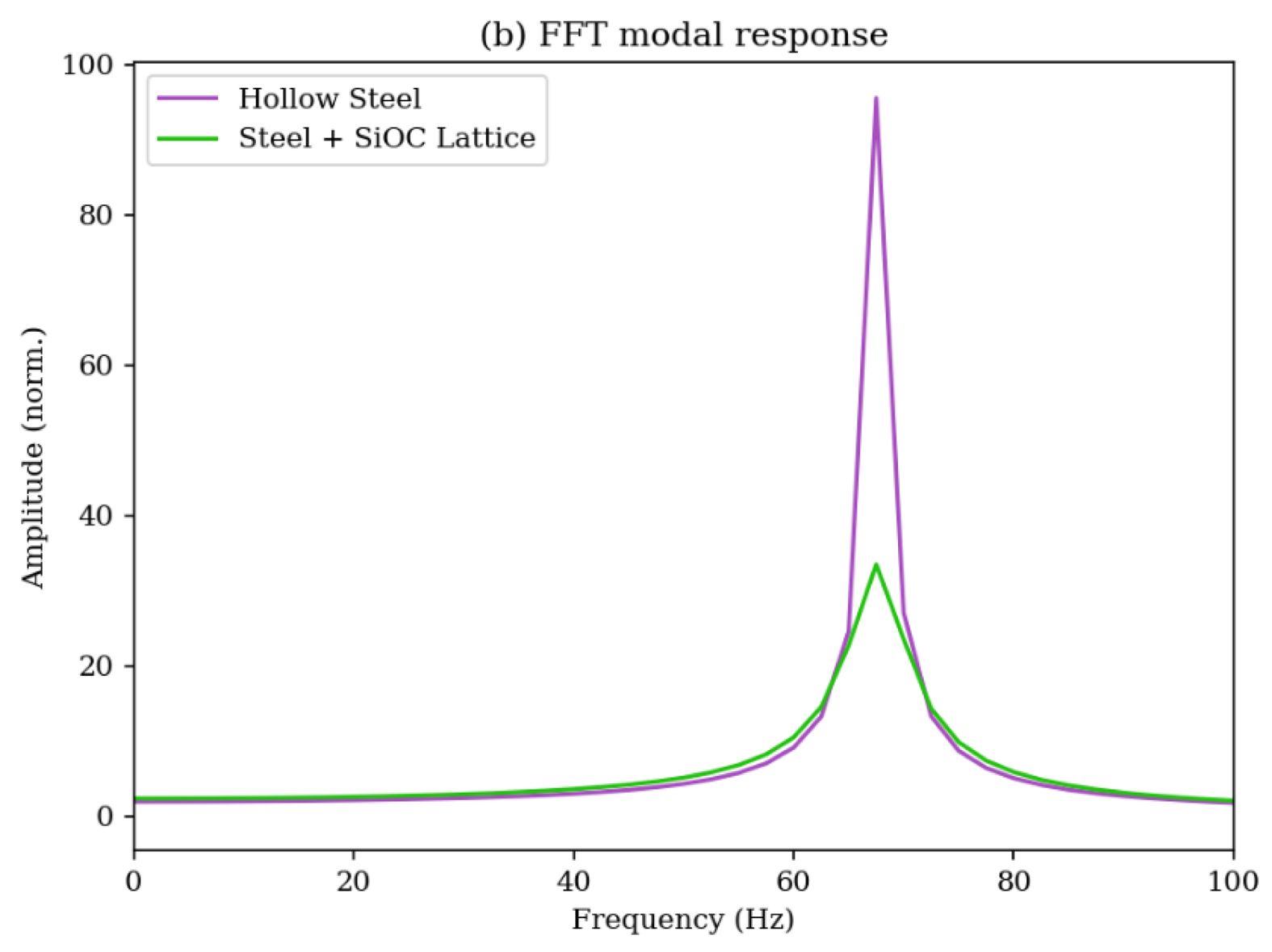
Frequency-domain analysis further supports this effect. As shown in Fig. 2, the reference hollow steel bar displayed a sharp modal peak at ~72 Hz. The same mode for the SiOC-integrated bar shifted downward to ~66 Hz and broadened with reduced amplitude. The downshift indicates a reduction in effective bending stiffness due to the compliant lattice insert, while the peak broadening and amplitude reduction are characteristic of increased modal damping. Such tailoring of vibrational behavior would allow manufacturers to tune “whip” characteristics based on specific strength disciplines, wherein Olympic lifting often benefits from delayed resonance while powerlifting benefits from suppressed oscillation [21, 22].
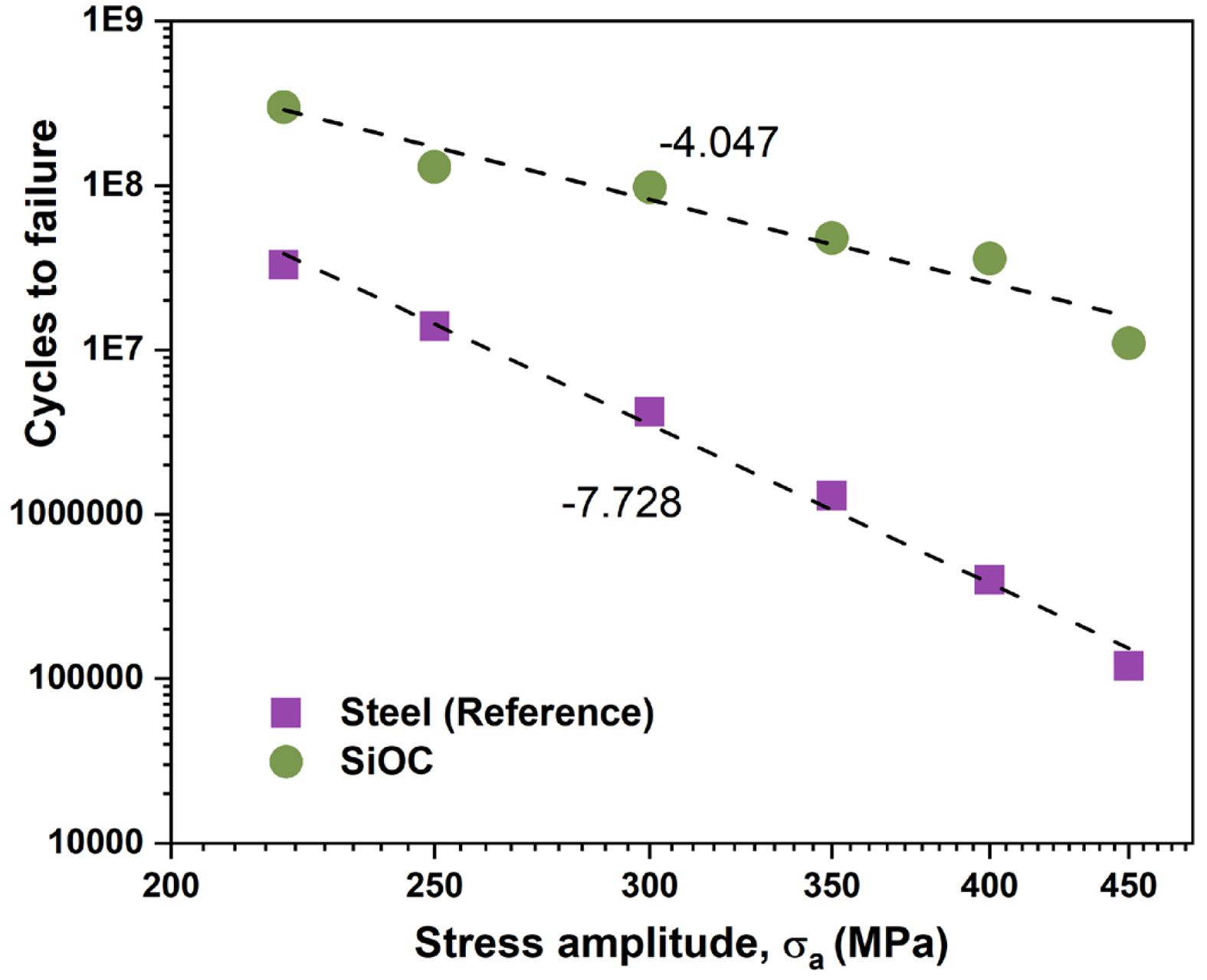
Fatigue performance showed a contrasting trend. The S–N data in Fig. 3 revealed that for a given stress amplitude, the SiOC-reinforced bar sustained a greater number of cycles before failure compared to the reference steel bar. Linear fits to the log–log S–N data yielded slopes of −7.728 for steel and −4.047 for the SiOC-integrated configuration. Although negative slopes are expected reflecting decreasing fatigue life with increasing stress amplitude the reduced magnitude for the SiOC configuration indicates a less severe degradation rate. At high-cycle fatigue levels (10⁷–10⁹ cycles), the SiOC lattice redistributed internal stresses along the bar axis, limiting crack initiation sites and delaying microstructural damage accumulation. These results demonstrate that internal mechanical regulation can enhance fatigue resistance without requiring changes to the bar’s external metallurgy.
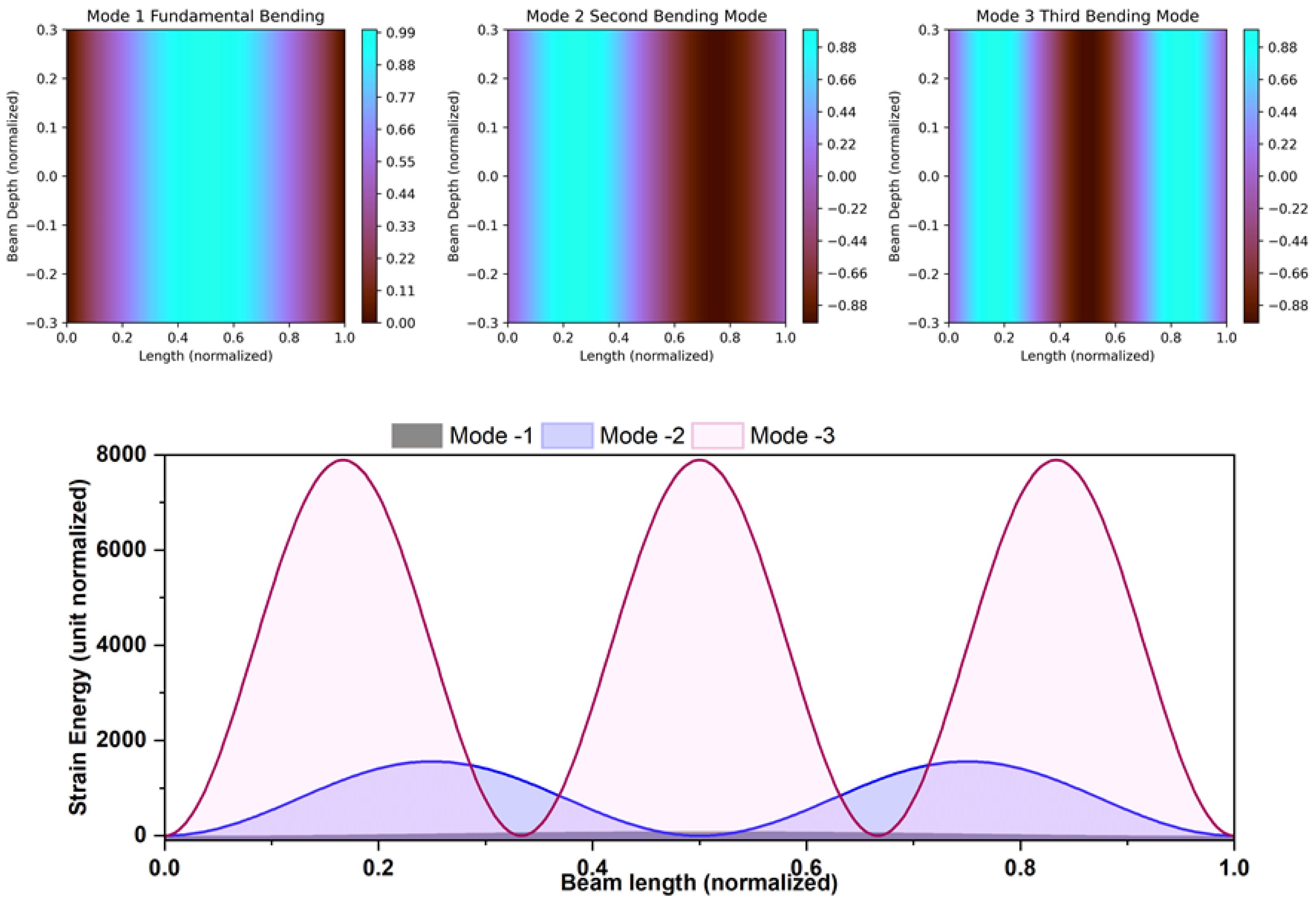
Finite-element mode shape calculations (Fig. 4) further elucidate the mechanism behind the observed behaviors. The first three bending modes of a slender beam showed no discontinuities or localized strain intensification when the SiOC lattice was modeled as an internal compliant medium. Instead, the strain contours exhibited well-distributed modal fields along the beam neutral axis, suggesting that the lattice acts as a strain-modulating medium rather than a rigid reinforcing insert. This agrees with damping-driven rather than stiffness-driven behavior and supports the hypothesis that fatigue improvements arise from microstrain homogenization rather than hard reinforcement.
Figure 4 presents the computed bending mode shapes and corresponding strain energy distributions of the beam structure for the first three bending modes under free-free conditions. The contour plots reveal the characteristic spatial deformation patterns for each mode, while the energy plots quantify the localization trend of modal strain energy along the beam length.
For the fundamental mode (Mode 1), the deformation profile exhibits a single half-wave with maximum deflection at the mid-span and nodes located at the free ends. The associated strain energy remains minimal across the entire span, indicating that Mode 1 involves low curvature and therefore low bending energy. This behaviour is consistent with classical Euler-Bernoulli beam theory, wherein the first mode exhibits the lowest modal stiffness and stores the least strain energy [7, 23].
In contrast, Mode 2 introduces an additional inflection point and node at the mid-span, resulting in two symmetric curvature regions. The strain energy distribution reveals two distinct peaks located at approximately one-quarter and three-quarter lengths, where the bending curvature is maximized. Compared to Mode 1, the stored strain energy increases substantially, reflecting the higher modal stiffness and internal deformation work required for excitation of the second mode. Mode 3 further increases geometric complexity, exhibiting two internal nodes and three curvature lobes. As a result, the strain energy distribution shows three dominant peaks with significantly higher magnitude compared to Modes 1 and 2. This amplification reflects the cumulative effect of increased curvature intensity and reduced effective modal wavelength [24]. Quantitatively, the maximum normalized strain energy in Mode 3 exceeds that of Mode 2 by approximately an order of magnitude, indicating that higher-order bending modes demand considerably greater deformation work.
|
Fig. 1 Time-domain vibrational decay response of the beam for hollow steel and steel+SiOC configurations under identical excitation conditions. |
|
Fig. 2 Frequency-domain FFT spectra showing modal frequency shift between hollow steel and steel+SiOC beams. |
|
Fig. 3 S-N fatigue behavior comparing hollow steel and SiOCreinforced beams, illustrating differences in fatigue strength and slope. |
|
Fig. 4 First three bending mode shapes (top) and corresponding normalized strain energy distributions (bottom) for the beam structure. |
This study demonstrates that integrating a compliant polymer-derived SiOC lattice into the hollow core of a steel barbell provides a viable pathway for engineering its internal mechanical response without altering external metallurgy, mass balance, or handling geometry. The SiOC lattice insert introduced additional internal energy-dissipation mechanisms that increased modal damping by approximately 3.5× relative to the hollow steel reference. This enhancement reduced free-decay settling time by ~63% and suppressed modal amplitude, indicating that lattice-assisted damping can actively regulate oscillatory behavior relevant to both Olympic and powerlifting applications. Frequency-domain analysis further confirmed a downward shift in the dominant bending mode and broadening of the modal peak, consistent with coupling between the compliant ceramic lattice and steel envelope. Fatigue testing revealed that the SiOC-reinforced configuration exhibited a shallower S–N slope, suggesting reduced sensitivity to increasing stress amplitude and improved high-cycle fatigue resistance. These fatigue advantages are attributed to distributed microstrain homogenization and delayed crack initiation facilitated by the lattice topology rather than by direct load-bearing reinforcement. Complementary finite-element mode shape and strain-energy analyses showed that higher-order bending modes localize significantly more strain energy than the fundamental mode and confirmed that the SiOC insert mitigates curvature intensification without introducing stress discontinuities. Collectively, the results establish that internal ceramic architectures can expand the functional design space of structural steel components by enabling selective tuning of damping, stiffness, and fatigue behavior. For barbell applications, such internal mechanical regulation offers the possibility of discipline-specific performance tuning enhanced damping for powerlifting stability and controlled whip for Olympic lifts using a unified structural platform. Beyond barbells, the hybrid steel SiOC strategy may be transferable to shafts, beams, and tubular components where vibration suppression and fatigue life are critical. Future work may focus on optimizing lattice topology, porosity gradients, and ceramic–metal interface mechanics, as well as scaling to full-length barbells under realistic lifting dynamics.
- 1. M.B. Anderson, Res. Q. Am. Assoc. Health Phys. Educ. 50[4] (1979) 541-553.
-

- 2. J. Mueller, K.H. Matlack, K. Shea, and C. Daraio, Adv. Theory Simul. 2[10] (2019) 1900081.
-
- 3. Z. Yu, R. Savinov, M. Matura, P. Zhang, and J. Shi, Thin-Walled Struct. 215 (2025) 113490.
-
- 4. H. Lei, C. Li, J. Meng, H. Zhou, Y. Liu, X. Zhang, P. Wang, and D. Fang, Mater. Des. 169 (2019) 107685.
-
- 5. M. Sanami, N. Ravirala, K. Alderson, and A. Alderson, Procedia Engineering 72 (2014) 453-458.
-
- 6. H. Yin, W. Zhang, L. Zhu, F. Meng, J. Liu, and G. Wen, Compos. Struct. 304 (2023) 116397.
-
- 7. M. Brannigan and S. Adali, Med. Sci. Sports Exerc. 13[1] (1981) 44-53.
-
- 8. J. Buckley and D. Kerwin, Ergonomics 31[11] (1988) 1621-1629.
-
- 9. H. Cui, R. Hensleigh, H. Chen, and X. Zheng, J. Mater. Res. 33[3] (2018) 360-371.
-
- 10. T. Lacelle, K.L. Sampson, H. Yazdani Sarvestani, A. Rahimizadeh, J. Barroeta Robles, M. Mirkhalaf, M. Rafiee, M.B. Jakubinek, C. Paquet, and B. Ashrafi, APL Mater. 11[7] (2023) 070602.
-
- 11. G.D. Sorarù and D. Suttor, J. Sol-Gel Sci. Technol. 14[1] (1999) 69-74.
-
- 12. K. Kanga and J. Yunb, J. Ceram. Process. Res. 12[5] (2011) 583-587.
-
- 13. A. Francis, Mater. Res. Express 5[6] (2018) 062003.
-
- 14. J.O.B. Rivera, M.H. Talou, Y.X. Hung Hung, and M.A. Camerucci, J. Sol-Gel Sci. Technol. 91[3] (2019) 446-460.
-
- 15. G.J. Leonel, S.B. Mujib, G. Singh, and A. Navrotsky, Int. J. Ceram. Eng. Sci. 4[5] (2022) 315-326.
-
- 16. G.J. Leonel, X. Guo, G. Singh, and A. Navrotsky, Open Ceram. 15 (2023) 100402.
-
- 17. E. Jeon, H. Kim, and J. Yun, J. Ceram. Process. Res. 13[3] (2012) 239-242.
-
- 18. H. Brody, J. Appl. Biomech. 3[3] (1987) 293-296.
-
- 19. J. Kotze, S.R. Mitchell, and S. Rothberg, Sports Eng. 3[2] (2000) 67-84.
-
- 20. R. Cross, Am. J. Phys. 72[5] (2004) 622-630.
-
- 21. G.O. Rosvold and O.J. Løkberg, Appl. Opt. 32[5] (1993) 684-691.
-
- 22. N. Timme and A. Morrison, J. Acoust. Soc. Am. 125[6] (2009) 3650-3656.
-
- 23. O.J. Løkberg and G.Å. Slettemoen, Appl. Opt. 20[15] (1981) 2630-2634.
-
- 24. C.L. Stroede, L. Noble, and H.S. Walker, J. Sports Sci. 17[5] (1999) 379-385.
-
 This Article
-
2026; 27(1): 185-189
Published on Feb 28, 2026
- 10.36410/jcpr.2026.27.1.185
- Received on Nov 13, 2025
- Revised on Feb 3, 2026
- Accepted on Feb 4, 2026
Services
Shared
Correspondence to
- Hongning Lv
-
Department of Physical Education, Heilongjiang University of Science and Technology, Harbin, 150022, Heilongjiang, China
Tel : +86-13845126323 Fax: +86-0451-88036225 - E-mail: lvhongning@usth.edu.cn
 Copyright 2019 International Orgranization for Ceramic Processing. All rights reserved.
Clean-Energy Research Institute(CRI), Hanyang University, 222, Wangsimni-ro, Seongdong-gu, Seoul, 04763, Korea
E-mail: jcpr@hanyang.ac.kr