







 Articles
 - Mechanical strength enhancement of aluminum nitride ceramics via h-BN-assisted sintering
Xianju Zhenga,*, Fang Lib and Yuedong Chenc
aSchool of Civil Engineering, Zhengzhou College of Finance and Economics, ZhengZhou 450053, China
bSchool of Architectural Engineering and Art Design, Henan Vocational College of Information and Statistics, ZhengZhou 450008, China
cThe Fourth Construction Co., Ltd. of China Construction Fifth Engineering Bureau, Luoyang 471000, ChinaThis article is an open access article distributed under the terms of the Creative Commons Attribution Non-Commercial License (http://creativecommons.org/licenses/by-nc/4.0) which permits unrestricted non-commercial use, distribution, and reproduction in any medium, provided the original work is properly cited.
Aluminum nitride (AlN) ceramics are widely used in advanced electronic and thermal management applications due to their high thermal conductivity and favorable mechanical properties. However, achieving high densification and optimized mechanical performance remains a challenge during sintering. In this study, the effect of hexagonal boron nitride (h-BN) as a sintering additive on the sintering behavior, densification kinetics, microstructure, and mechanical properties of AlN ceramics was systematically investigated. High-purity AlN powders with varying h-BN contents were prepared via ball milling and consolidated using hot pressing at 1900 °C under a nitrogen atmosphere. The results reveal that increasing h-BN content reduces the required sintering temperature, attributed to the lubricating effect of h-BN that enhances particle rearrangement during sintering. An optimal h-BN concentration range (1-3 wt%) was identified, providing a favorable balance between densification rate and microstructural refinement. SEM analysis confirmed that h-BN addition significantly reduced porosity and promoted a more uniform and compact microstructure compared to monolithic AlN. Mechanical testing demonstrated a substantial improvement in tensile strength, with h-BN-reinforced AlN exhibiting an ultimate tensile strength of approximately 260 MPa, compared to 145 MPa for pure AlN. Although a slight reduction in ductility was observed, the enhanced stiffness and strength indicate effective load transfer and crack-bridging mechanisms introduced by h-BN.
Keywords: Aluminum nitride, Hexagonal boron nitride, Densification.
Ceramic materials, owing to their diverse applications ranging from electronics to aerospace, continually demand advancements in processing techniques to optimize their properties. Aluminum nitride (AlN) ceramics, in the area of the sintering process plays a pivotal role in determining the final characteristics of these materials. The incorporation of sintering additives has emerged as a key strategy to tailor the properties of AlN ceramics, enhancing their performance for specific applications. Sintering, a process involving the consolidation of ceramic powders at elevated temperatures, is critical for achieving the desired density, microstructure, and mechanical properties in the final ceramic product. To overcome challenges associated with traditional sintering methods, the introduction of additives has become a focal point of research. These additives are carefully selected based on their ability to influence the kinetics of densification, sintering temperatures, and, consequently, the overall performance of AlN ceramics. This research delves into the broader landscape of sintering additives in AlN ceramic processing, seeking to understand their diverse roles and impact on the final material properties. The utilization of additives becomes especially crucial as industries demand ceramics with enhanced thermal conductivity, mechanical strength, and tailored functionalities. The utilization of the hot pressing method not only serves to reduce sintering time but also proven effective in enhancing sintering densification [1]. In a study conducted by Jin et al. [2], capsule-like h-BN-coated AlN powders were prepared through a nitridation reaction in nitrogen gas. These powders were subsequently sintered using the hot-pressing technique with varying BN content. The flexural strength of the resulting composite ceramics exhibited a gradual decline with an increase in BN content. Makarenko et al. [3] employed low-temperature aluminum diboride as a precursor to generate composite AlN–BN-based powders. The compact samples derived from these synthesized powders demonstrated a bending strength ranging from 235 to 240 MPa when subjected to hot pressing. In a separate investigation, He et al. [4] produced AlN–BN composites using Sm2O3–CaF2 as sintering additives through spark plasma sintering. Their research delved into the influence of additives and h-BN content on sample properties, revealing that the highest thermal conductivity value reached 85 W·m−1·K−1 with the introduction of 8 wt% sintering aids.
In this context, the exploration of various sintering additives becomes paramount, with a focus on their synergistic effects during the sintering process. The aim is not only to achieve densification but also to fine-tune the microstructure and mechanical attributes of AlN ceramics. Among the various potential additives, hexagonal boron nitride (h-BN) stands out as a candidate of interest due to its unique thermal stability and lubricating properties [5-9]. As industries continue to push the boundaries of material performance, understanding the intricate relationships between sintering additives and the resulting properties of AlN ceramics becomes imperative. This research contributes to the ongoing discourse in ceramic science and engineering, offering insights into the nuanced role of additives in tailoring the sintering behavior of AlN ceramics for diverse and specialized applications. In the field of advanced ceramic materials, the integration of additives to optimize processing parameters and enhance material properties is a topic of paramount importance. Among these additives, hexagonal boron nitride (h-BN) has emerged as a promising candidate, demonstrating unique thermal stability and lubricating properties. This research delves into the synergistic effects of h-BN when employed as sintering additives in the processing of AlN ceramics. However, the sintering process plays a critical role in determining the final properties of AlN ceramics. This study seeks to assess how the strategic incorporation of h-BN can influence the sintering behavior and overall performance of AlN-based materials. The choice of h-BN as a sintering aid stems from its distinctive characteristics, including thermal stability and lubricating properties. These properties make h-BN a compelling candidate to enhance the densification process during sintering, with potential benefits for the microstructural and mechanical properties of the resulting AlN ceramics. The investigation aims to unravel the intricacies of this synergistic relationship by varying concentrations of h-BN during the sintering process. The outcomes of this study are anticipated to contribute significantly to the optimization of processing parameters and the advancement of high-performance ceramic materials. As industries continue to demand materials with enhanced properties, the exploration of innovative additives such as h-BN holds promise for shaping the landscape of ceramic processing and application.
High-purity raw powders were meticulously prepared as the foundation for the ceramic processing. Scaled quantities of raw powders were subjected to a thorough ball milling process for 12 hours. This milling operation employed high-purity zirconia milling balls as grinding media. The ball milling was conducted in an anhydrous ethanol medium, ensuring an optimal environment for powder refinement. Slurry Formation and Drying: Following the ball milling, the resulting powder mixtures were transformed into slurries through a carefully controlled process. The slurries were maintained at 65 ℃ in a rotary vacuum evaporator, facilitating the removal of the ethanol medium and promoting homogeneity within the powder mixture. Subsequently, the dried powder mixture underwent an additional drying phase for 24 hours at 80 ℃ in a drying oven. To further enhance powder homogeneity and reduce agglomeration, the dried powders were screened through a 200-mesh sieve. Sintering Process: The prepared and refined powder mixtures were subjected to a controlled sintering process to achieve the desired ceramic characteristics. The sintering process was executed in a state-of-the-art hot press furnace with a heating rate of 20 ℃/min. The sintering temperature was set at 1900 ℃, and the duration was precisely maintained for 1 hour. This thermal treatment was carried out under a pressure of 50 MPa in a nitrogen atmosphere, ensuring optimal conditions for the consolidation and densification of the ceramic materials.The structural features of the sintered AIN were evaluated using scanning electron microscopy (SEM) analysis. Tensile tests were performed on control and composite specimens using a universal testing machine to obtain the stress-strain curve and determine the ultimate tensile strength of the material.
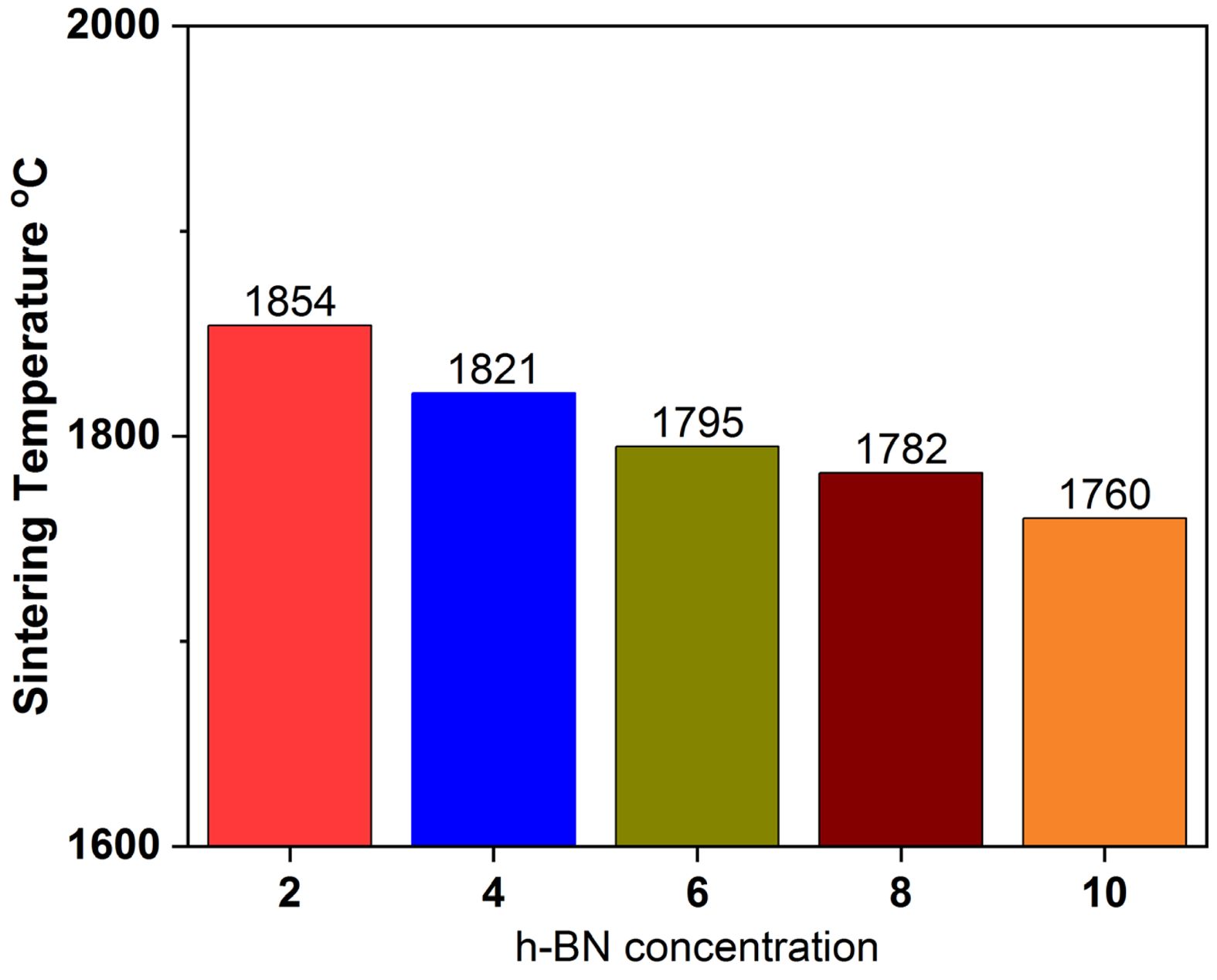
The incorporation of hexagonal boron nitride (h-BN) as a sintering additive introduces a dynamic element to the thermal processing of aluminum nitride (AlN) ceramics. Varying concentrations of h-BN in the sintering process play a crucial role in influencing the achieved sintering temperatures, thereby impacting the overall densification and material properties. As observed in the Fig. 1, there is an inverse relationship between h-BN concentration and sintering temperature. As the concentration of h-BN increases, the required sintering temperature decreases. This phenomenon aligns with the lubricating properties of h-BN, which facilitates enhanced particle rearrangement and densification at lower temperatures [10, 11]. The data suggests the potential for optimizing sintering temperatures based on the desired characteristics of the final AlN ceramics. Lowering sintering temperatures not only conserves energy but also may have implications for reducing thermal stresses and enhancing the overall efficiency of the manufacturing process. It is noteworthy that, beyond a certain concentration (e.g., 10%), the reduction in sintering temperature tends to stabilize. This indicates a potential saturation point where the benefits of h-BN concentration on lowering sintering temperature. While the focus here is on sintering temperatures, the observed trends in the data should be correlated with microstructural analyses to understand the impact on the final properties of AlN ceramics. The influence of varying h-BN concentrations on grain size, porosity, and phase composition should be explored to comprehensively assess material characteristics.
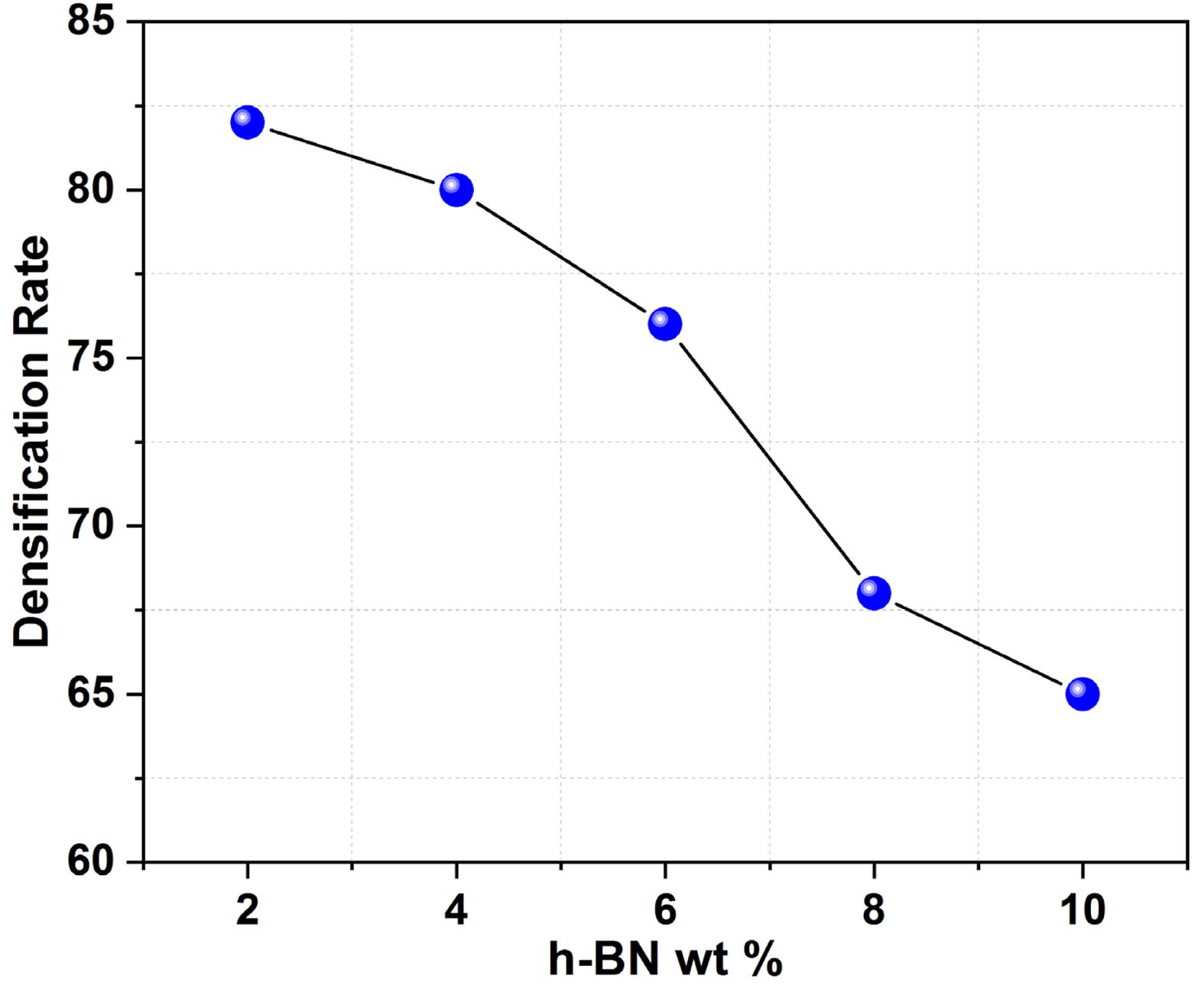
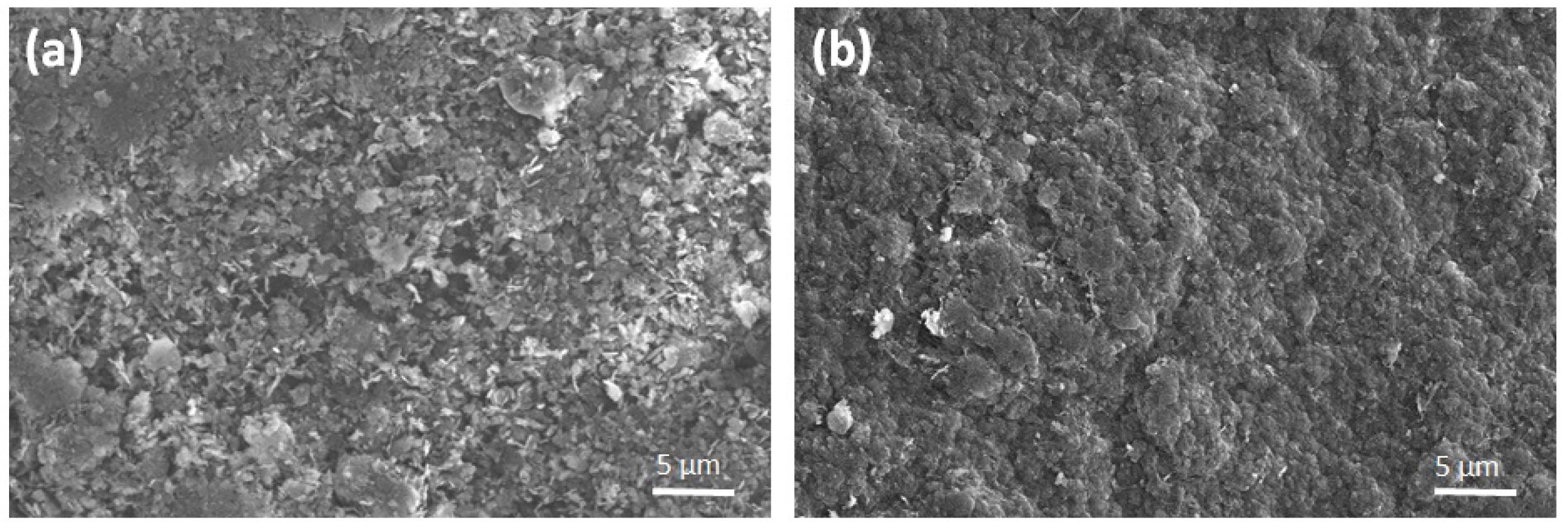
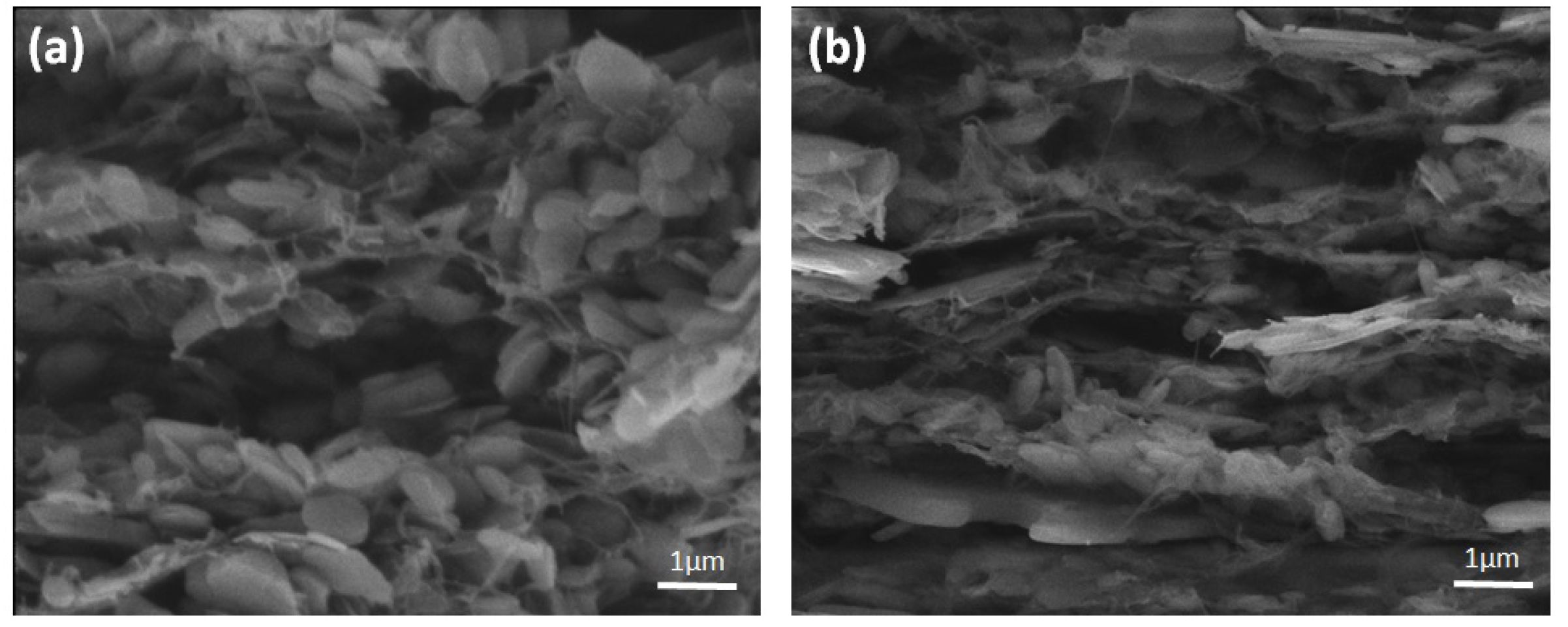
The addition of hexagonal boron nitride (h-BN) as a sintering additive introduces a dynamic element to the densification kinetics during the processing of aluminum nitride (AlN) ceramics. Varying concentrations of h-BN significantly influence the rate and extent of densification, shaping the microstructure and, consequently, the final properties of the ceramics. Moreover, as the concentration of h-BN increases, there is a consistent trend of decreasing densification rates. This can be attributed to the lubricating properties of h-BN, which promote enhanced particle rearrangement but may reduce the overall driving force for densification. Optimal Concentration for The data suggests that at lower concentrations (e.g., 1-3%), the densification rate is relatively high, indicating efficient particle packing. This range may be considered optimal for achieving substantial densification while maintaining favorable processing kinetics [12, 13]. Trade-off between Lubrication and Densification. Higher concentrations of h-BN (e.g., 7-10%) exhibit reduced densification rates (Fig. 2). This emphasizes a trade-off between the lubricating effect of h-BN, which aids in particle movement, and the necessity for strong particle bonding during densification (Fig. 2). The challenge lies in balancing these contrasting effects to achieve the desired material properties. The observed trends in densification kinetics correlated with microstructural analyses to understand the implications for grain growth, porosity, and overall structural integrity (Fig. 3 and Fig. 4). SEM micrographs of sintered AlN without h-BN additive revealed a relatively porous microstructure with irregular grain boundaries, indicating incomplete densification (Fig. 3a and 4a). In contrast, the AlN samples containing h-BN exhibited a more uniform and compact microstructure with reduced porosity, suggesting enhanced particle rearrangement during sintering (Fig. 3b and 4b). The presence of h-BN appears to promote better densification, likely due to its lubricating effect, which facilitates grain sliding and packing. These observations indicate that h-BN plays a beneficial role in improving the microstructural quality of sintered AlN ceramics.
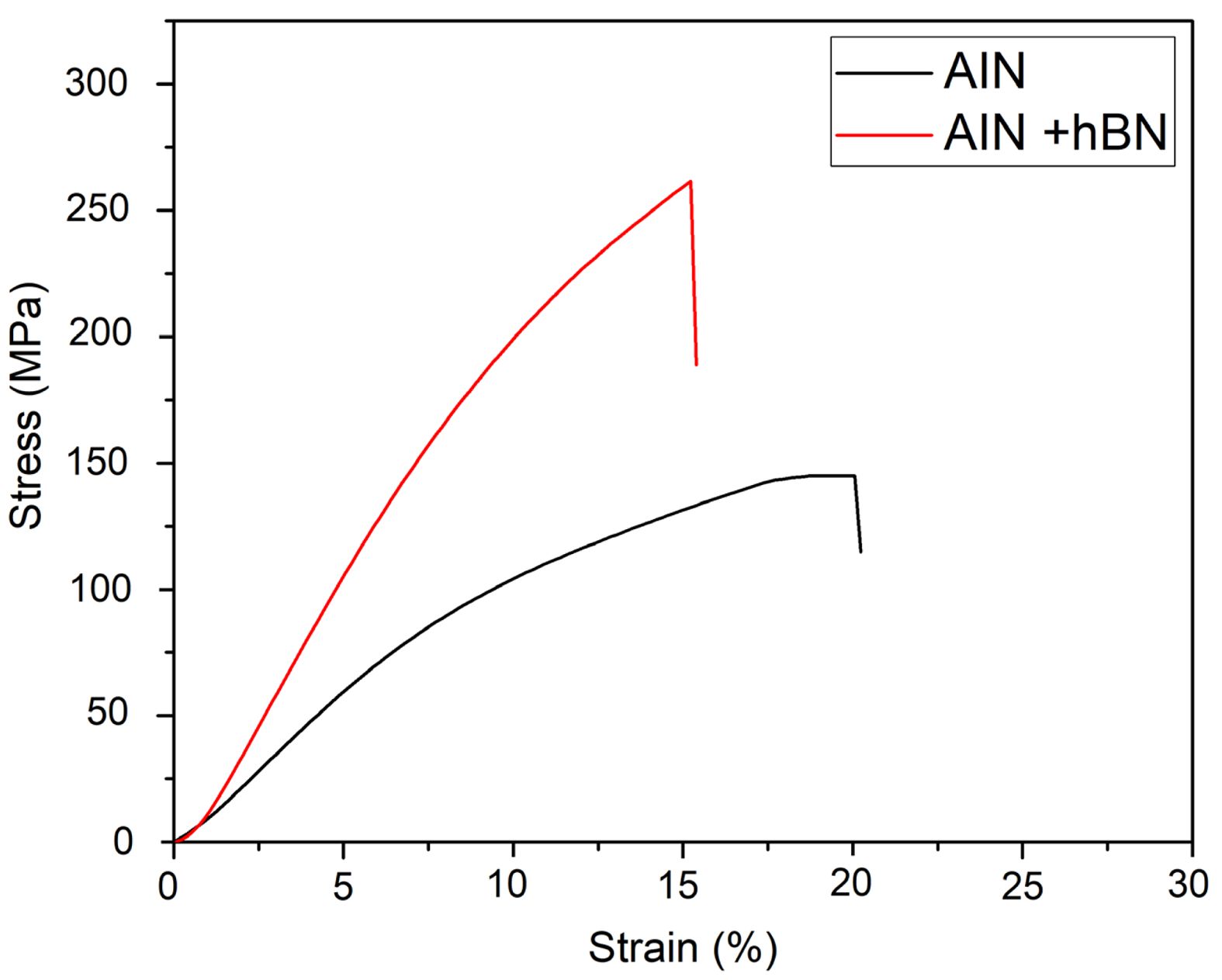
The tensile curves show clear mechanical enhancement with h-BN addition to AlN (Fig. 5). The composite (AlN + h-BN) exhibits a significantly higher ultimate tensile strength (~260 MPa) compared to control AlN (~145 MPa), indicating improved load-bearing capability. The higher initial slope of the composite curve indicates an increase in elastic modulus, suggesting that the stiff h-BN phase enhances load transfer within the matrix. The composite’s higher strength can be attributed to effective stress distribution and crack-bridging mechanisms provided by h-BN platelets, which delay crack initiation and propagation. The reinforcement likely restricts matrix deformation, resulting in greater resistance to applied tensile loads. Strain to failure is slightly reduced in the composite (~16%) relative to pure AlN (~20%), implying a modest loss in ductility [14-16]. The sharp stress drop after the peak in the curve suggests a more abrupt fracture, characteristic of a stiffer but more brittle material. The h-BN addition significantly improves tensile strength and stiffness but introduces a trade-off with ductility. This balance of properties is typical of ceramic–ceramic composites, where reinforcement enhances strength while limiting plastic deformation, making the material suitable for high-strength, moderate-strain structural applications.
Achieving full densification while preserving mechanical integrity requires careful optimization of processing conditions. The combined effects of h-BN content, sintering temperature, and densification behavior must be evaluated together, as each factor influences microstructural development and final performance. Understanding how these parameters interact helps define an effective thermal processing window for AlN-based ceramics, ensuring improved strength and reliability without sacrificing structural stability.
|
Fig. 1 Effect of h-BN concentration on the Sintering temperature. |
|
Fig. 2 Effect of h-BN concentration on the Densification Rate. |
|
Fig. 3 SEM surface image of sintered AlN ceramics (a) without h-BN and, (b) with h-BN. |
|
Fig. 4 SEM cross sectional image of sintered AlN ceramics (a) without h-BN, and (b) with h-BN. |
|
Fig. 5 Tensile stress–strain curves of control and h-BN reinforced AlN. |
In conclusion, the manipulation of h-BN concentrations during the sintering process offers a versatile tool for tailoring sintering temperatures and, consequently, the processing parameters of AlN ceramics. This understanding provides a foundation for optimizing the synthesis of high-performance ceramics with desired properties for specific applications. Further investigations into the nuanced effects of varying h-BN concentrations on microstructure and material properties will contribute to the broader understanding of advanced ceramic processing. The influence of varying concentrations of h-BN on densification kinetics underscores the intricate relationship between lubrication and densification. The findings offer valuable insights into optimizing the synthesis of AlN ceramics by strategically manipulating h-BN concentrations, paving the way for enhanced control over material properties and processing efficiency. Further investigations into the microstructural consequences of these kinetics will contribute to a comprehensive understanding of advanced ceramic processing.
This work was supported by the Key scientific research projects of the Henan Provincial Scicnce and Technology Rescarch Project (No. 242102240037).
- 1. W.S. Cho, M.W. Cho, J.H. Lee, and Z.A. Munir, Mater. Sci. Eng: A 418[1] (2006) 61-67.
-

- 2. H.Y. Jin, W. Wang, J.Q. Gao, G.J. Qiao, and Z.H. Jin, Mater. Lett. 60[2] (2006) 190-193.
-
- 3. G.N Makarenko, L.A. Krushinskaya, V.B. Fedorus, T.V. Dubovik, A.V. Kotko, M.G. Andreeva, and I.V. Uvarova, Powder Metall. Met. Ceram. 49 (2011) 670-674.
-
- 4. X. He, Q. Gong, Y. Guo, and J. Liu. J. Alloys Compd. 675[5] (2016) 168-173.
-
- 5. S.H. Lee, H. Tanaka, and T. Aoyagi, J. Eur. Ceram. Soc. 29[10] (2009) 2021-2027.
-
- 6. M. Kakiage, Y. Tominaga, I. Yanase, and H. Kobayashi, Powder Technol. 221 (2012) 257-263.
-
- 7. S. Chuan, L. Xiaogang, C. Yunbo, Z. Lingli, and L. Yunkai, J. Ceram. Process. Res. 22[3] (2021) 340-344.
-
- 8. K.H. Kim, K.B. Shim, J.H. Chae, J.S. Park, and J.P. Ahn, J. Ceram. Process. Res. 10[6] (2009) 716-720.
-
- 9. Rafi-ud-dina, G.H. Zahida, Z. Asghar, Muhammad Maqbool, E. Ahmada, T. Azhar, T. Subhani, and M. Shahzada, J. Asian Ceram. Soc. 2[3] (2014) 268-274.
-
- 10. M. Alrwashdeh and S.A. Alameri, Energies 15[21] (2022) 8008.
-
- 11. C.P. Lin, C.H. Chu, S.B. Wen, and Y.H. Shen J. Ceram. Process. Res. 12[5] (2011) 525-529.
-
- 12. M. Alrwashdeh, S.A. Alameri, and A.K. Alkaabi, Nucl. Sci. Eng. 194[2] 2020 163-167.
-
- 13. Y.J. Joo, J.W. Kim, K.B. Shim, and C.J. Kim, J. Ceram. Process. Res. 19[4] (2018) 342-346.
-
- 14. C.D. Spataru, M.H. Crawford, and A.A. Allerman, Appl. Phys. Lett. 114 (2019) 011903.
-
- 15. J. Lee, H.W. Ahn, Y.S. Yoon, M.W. Cho, and W.S. Cho J. Korean Ceram. Soc. 42[8] (2005) 582.
- 16. Z. Liu, S. Zhao, T. Yang, and J. Zhou, J. Adv. Ceram. 10[6] (2021) 1317-1325.
-
 This Article
-
2026; 27(1): 163-167
Published on Feb 28, 2026
- 10.36410/jcpr.2026.27.1.163
- Received on Mar 10, 2024
- Revised on Feb 2, 2026
- Accepted on Feb 4, 2026
Services
- Abstract
introduction
materials and methods
results and discussion
conclusion
- Acknowledgements
- References
- Full Text PDF
Shared
Correspondence to
- Xianju Zheng
-
School of Civil Engineering, Zhengzhou College of Finance and Economics, ZhengZhou 450053, China
Tel : 13526781309 Fax: 037186650005 - E-mail: zxj830113@163.com
 Copyright 2019 International Orgranization for Ceramic Processing. All rights reserved.
Clean-Energy Research Institute(CRI), Hanyang University, 222, Wangsimni-ro, Seongdong-gu, Seoul, 04763, Korea
E-mail: jcpr@hanyang.ac.kr