







 Articles
 - Enhanced temperature stability of small-permittivity Li3Mg2SbO5F2-basic microwave dielectric ceramics through Ba3(VO4)2 addition
Cuijin Peia, Fanfan Pana, Qianjing Jiaa, Li Quana, Miao Chena, Weihong Liub, Guoguang Yaoa,*, Wei Zhanga,*and Yansheng Wangc
aSchool of Science, Xi’an University of Posts and Telecommunications, Xi’an 710121, China
bSchool of Electronic Energineering, Xi’an University of Posts and Telecommunications, Xi’an 710121, China
cXi'an Chaofan Optoelectronic Equipment Co., LTD, Xi’an 710121, ChinaThis article is an open access article distributed under the terms of the Creative Commons Attribution Non-Commercial License (http://creativecommons.org/licenses/by-nc/4.0) which permits unrestricted non-commercial use, distribution, and reproduction in any medium, provided the original work is properly cited.
Microwave ceramics with close-zero temperature coefficient of resonance frequency (τf~0 ppm/◦C) high quality factor (Q×f>50,000 GHz), small permittivity (εr<15), and low sintering temperature (Ts<950 oC) are gaining great attention in the field of fundamental research and 5G communication. Until now, ceramics owing aforementioned key metrics at the same time is quite rare. In this paper, the (1-x)Li3Mg2SbO5F2–xBa3(VO4)2 (x=0.2–0.4) counterparts had been fabricated through high temperature solid state reaction at 750–850 oC. X-ray diffraction and SEM-EDS analyses showed all the specimens are composed of two dissimilar phases: Ba3(VO4)2 and Li3Mg2SbO5F2. The εr, τf, and Q×f of Li3Mg2SbO5F2-host counterpart upgrade with the increase of Ba3(VO4)2 content, and a near-zero τf is obtained for the specimen with x=0.3. With increment of sintering temperature, the volume density, Q×f together with εr for 0.7Li3Mg2SbO5F2–0.3Ba3(VO4)2 ceramics rose first and reduced thereafter, yet its τf remained stable. An expected εr of 11.4, τf of 4.8 ppm/oC and Q×f of 50,600 GHz were achieved at x= 0.3 constituent sintered at 825 oC.
Keywords: Composite ceramics, Li3Mg2SbO5F2 oxyfluorides, Ba3(VO4)2, Temperature stability.
Recently, Li-containing oxyfluoride ceramics are drawing tremendous attentions owing to their fascinating low sintering temperature as well as eminent microwave dielectric properties (MDPs) [1–5]. Within the Sb2O5-LiF–Li2O–MgO system, a novel oxyfluoride namely, Li3Mg2SbO5F2, was reported. We found that the 825 oC-sintered Li3Mg2SbO5F2 oxyfluoride ceramics possess eminent MDPs at 9.2 GHz (εr =8.1, Q×f = 68, 500 GHz, τf = -54 ppm/◦C) [6]. Yet, its high negative τf value (-54 ppm/oC) of Li3Mg2SbO5F2 oxyfluoride ceramics impedes its practical applications to a great extent [7]. There are two primary approaches to modulate the MDPs, especially for τf: 1) selecting two compounds with converse τf to construct diphase ceramics and 2) by ion replacement to construct a solid solution [8-10]. The solid solution Sr1+2xLa2-2xAl2-2xTi2xO7 (x = 0.55, τf ≈3.3 ppm/oC) and (1-x)Mg6Ti5O16-xCa0.8Sr0.2TiO3 diphase ceramics (x = 0.22, τf ~ -1.28 ppm/oC) are the most suitable samples among the situations aforementioned [11, 12].
With this regard, the Ba3(VO4)2 with positive τf (40.0 ppm/oC) was introduced to tune the MDPs of Li3Mg2SbO5F2-host ceramics [13, 14]. Thus, the (1-x)Li3Mg2SbO5F2–xBa3(VO4)2 (x=0.2-0.4) diphase ceramics were designed and fabricated based on a solid state reaction at 750–850 oC. The impact of Ba3(VO4)2 addition on the phase constituents, sintering behavior, microstructures together with MDPs of the 0.3Li3Mg2SbO5F2–0.7Ba3(VO4)2 sintered specimens was thoroughly investigated.
Through a solid-state process the (1-x)Li3Mg2SbO5F2–xBa3(VO4)2 (x=0.2-0.4) (abbreviated as LMSOF-BV) specimens were fabricated. Based on stoichiometric Li3Mg2SbO5F2 and Ba3(VO4)2, the initial materials of MgO, Li2CO3, MgF2, V2O5, BaCO3 (all purity>98.0 %) were separately weighed, then were individually mixed via planetary milling for 9 h with anhydrous alcohol as medium. The dried Li3Mg2SbO5F2 and Ba3(VO4)2 slurries were individually presintered under 750 oC/4 h and 650 oC/20 h. Subsequently, the LMSOF-BV mixture powders were re-milled for 9 h. By adding 6 wt% PVA binder, the above mixture powders were granulated, and compacted into green discs with diameter of 10 mm and thickness around 4.5 mm. Finally, these discs were fired under 750 oC–850 oC for 5 h in air atmosphere.
The phase identification, structural investigation along with fracture surface morphology of the LMSOF-BV samples were examined via X-ray diffraction (XRD, Japan) and scanning electron microscopy (SEM, Czech). The volume densities of fired specimens were trialed employing Archimedes’ drainage approach. With the help of resonant cavity method, the εr and Qxf values under microwave region about 10–11 GHz of the LMSOF-BV ceramics were measured employing a vector network analyzer (Ceyer 3674D). The τf values were evaluated based on following expressions (1) [15].
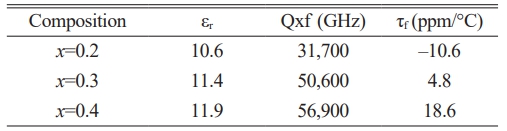
Table 1 summarizes the MDPs of 825 °C-sintered LMSOF-BV ceramics systems. As x rose from 0.2 to 0.4, the εr, τf and Qxf values gradually increased. An excellent overall MDPs could be obtained for the composition of x=0.3. Thereby, the following investigation was focused on the x=0.3 composition ceramics.
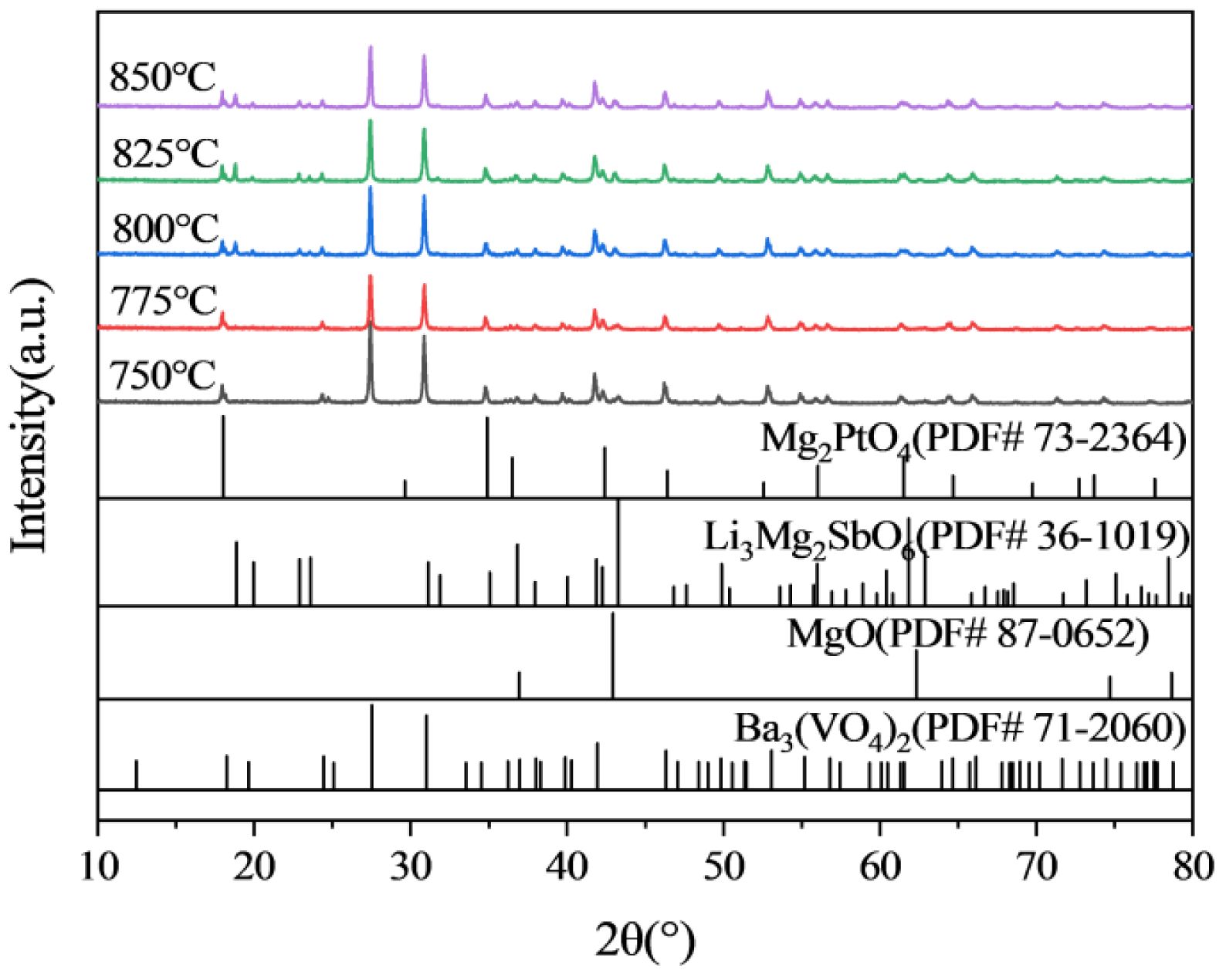
Fig. 1 gives the XRD plots of 0.7LMSOF-0.3BV ceramics sintered at 750–850 oC. All sintered bodies exhibited a similar phase assemble. All diffraction peaks match well with trigonal structural phase of Ba3(VO4)2 (PDF #71-2060) and Li3Mg2SbO5F2 [6, 16]. The achieved outcomes indicated the diphase ceramics of Li4Mg2SbO6F/Ba3(VO4)2 was formed without noticeable secondary phases, which could attribute to their diverse crystal structure [17].
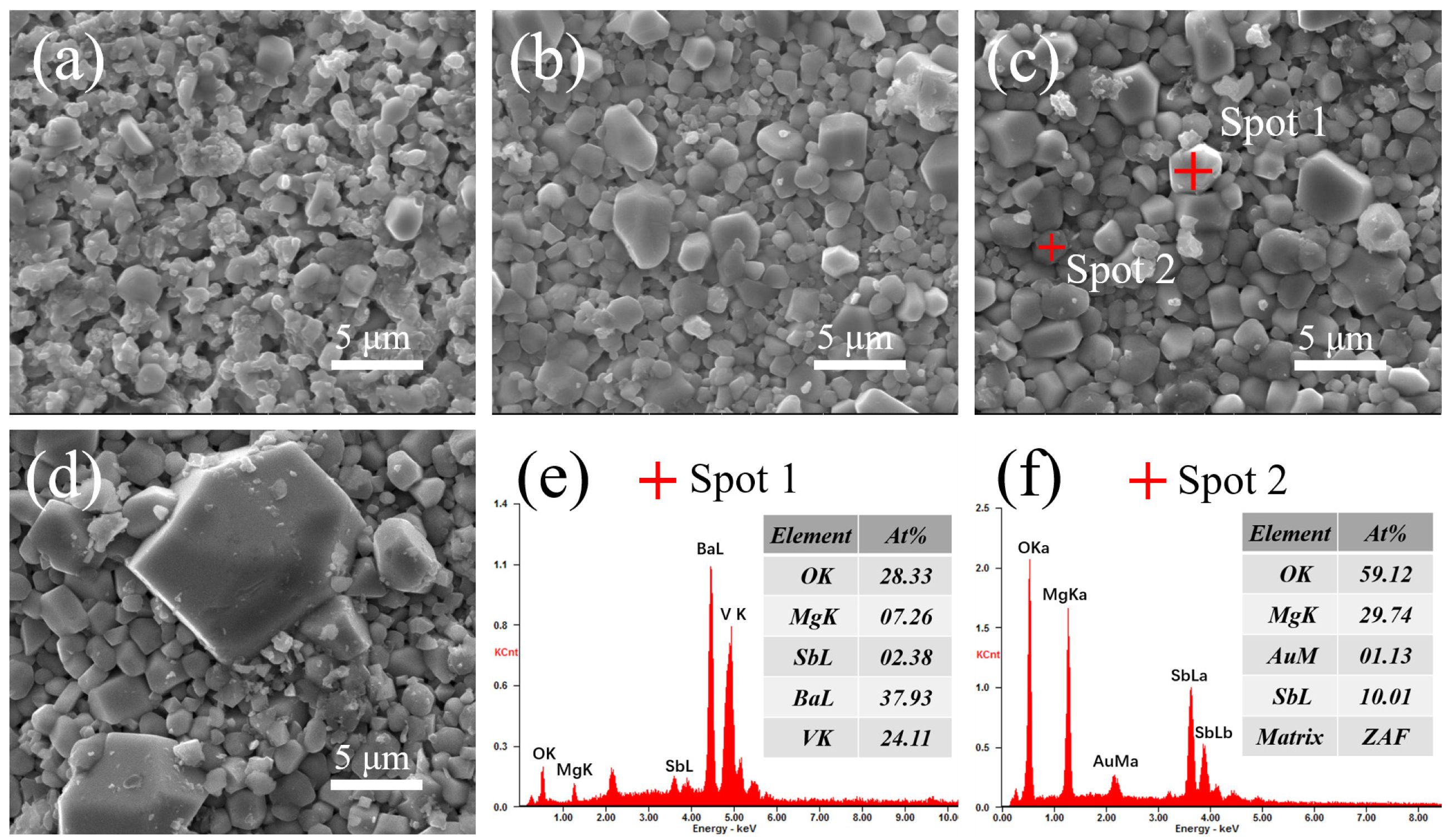
Fig. 2(a)–(f) display the fracture surface graphs and corresponding EDS spectra of 0.7LMSOF-0.3BV ceramics sintered at unlike temperatures. The 775 °C-sintered samples exhibited large number of intergranular pores, which tallied well with its poor density, as illustrated in Fig. 2(a) and Fig. 3. As the firing temperature rose, the intergranular pores declined and average grain size along with the homogeneity of grain size distribution grew. A dense microstructure accompanied by a relative uniform grain size distribution were gained for 825 ◦C-heated ceramics. Further increment the temperature to 850 oC, an unevenly grown grain emerged, as seen in Fig. 2(d), which would deteriorate the dielectric properties [18]. Moreover, all samples comprised two distinct-colored grains (white and black) marked in in Fig. 2(c). EDS analysis was carried out to identify the elemental composition of distinct-colored grains, and the resultant outcomes are presented in Fig. 2(e) and (f). Where the Ba and V element are enriched in white colored grains (spot 1), while Mg and Sb are enriched in black colored grains (spot 2), suggesting that white and black colored grains respectively corresponded to Ba3(VO4)2 and Li3Mg2SbO5F2 phase, which tallied well with the aforementioned XRD results.
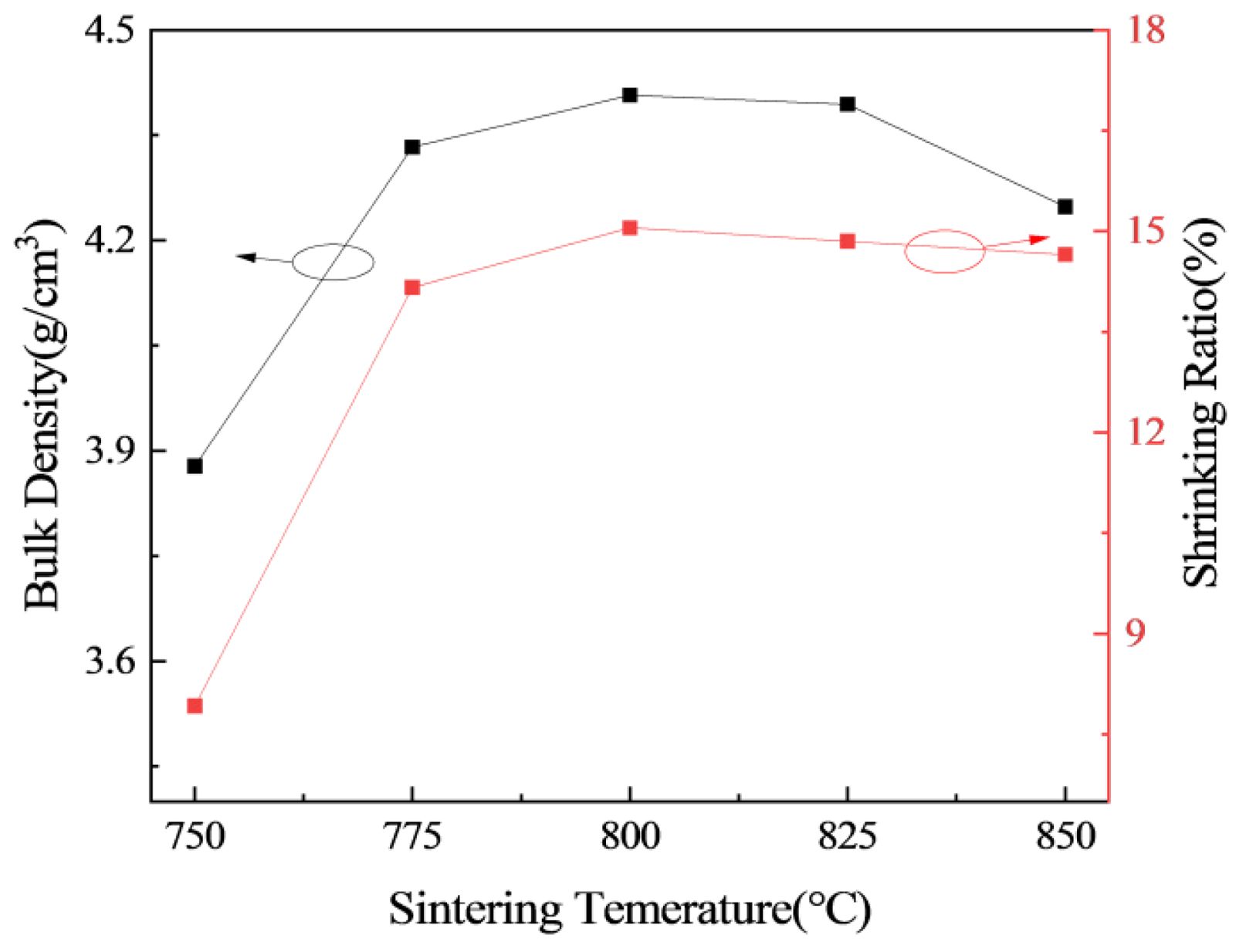
The density and shrinking ratio of 0.7LMSOF-0.3BV under different temperature sintering are displayed in Fig. 3 The density and shrinking ratio showed a similar tendency, initially rising and then reducing as sintering temperature rose. The increase in density and shrinking ratio could ascribe to that the gases from the pores within the ceramics flee with an increasement in firing temperature, the ceramics shrinks and thus brings about its density increment [19]. The decrease in density was due to the unevenly grown grain, as seen the SEM image in Fig. 2(d).
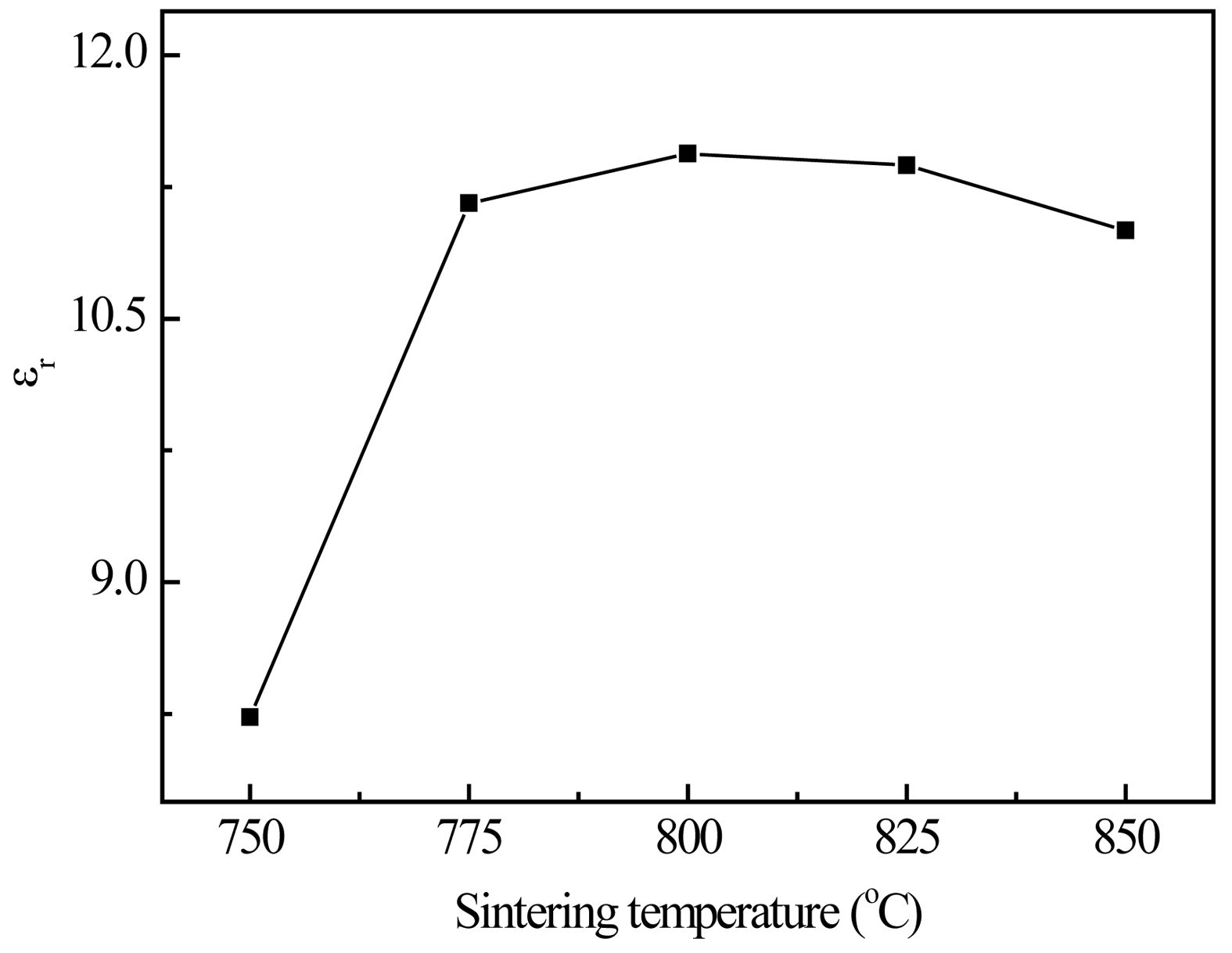
The dependence of εr over sintering temperature of the 0.7LMSOF-0.3LSO samples is exhibits in Fig. 4. The variation of ɛr with sintering temperature roughly shows an analogous inclination to that of densities (Fig. 2), since ɛr in microwave frequency is chiefly influenced by porosity for a fixed composition [20]. The εr of present ceramics displayed a stepwise increment with the wake of firing temperature, achieve a maximum value of 11.4 under 800 °C, and slightly declined with further increasing temperature. An abatement in porosity induces an increment in εr of present ceramics, because the εr of pores is near to 1. Additionally, an increase in average grain size also leads to an increase in εr due to the reduction in grain boundaries [21].
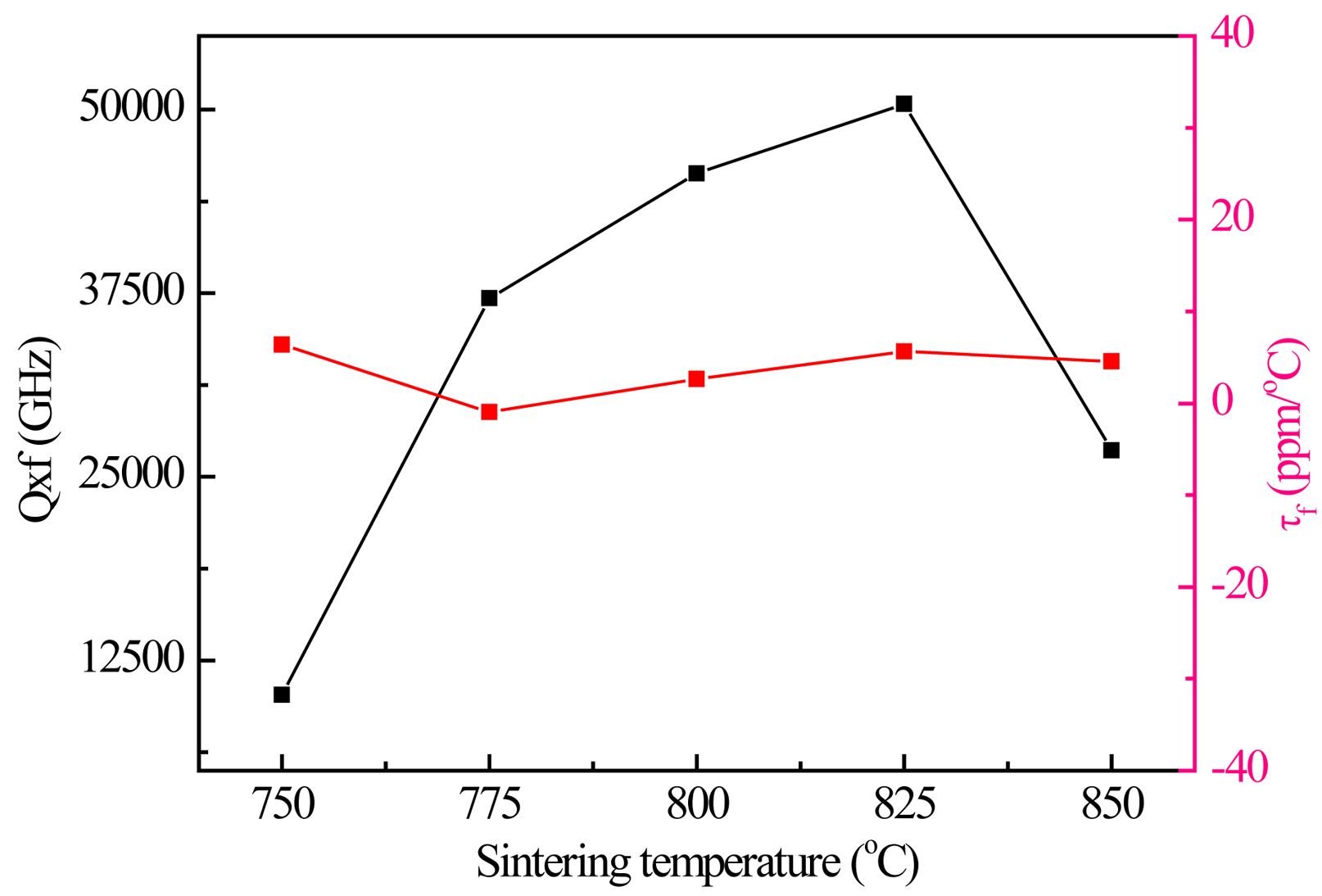
Figure 5 exhibits the change of Q×f and τf for the 0.7LMSOF-0.3BV composites over firing temperature. The change tendency of Q×f values over firing temperature is slightly different from the density and ɛr, because the influencing factors of Q×f are more complex, including intrinsic and non-intrinsic losses [22]. The present ceramics displayed a stepwise increment in Q×f values with the wake of firing temperature, achieve a peak value of 50,600 GHz at 825 °C, and slightly declined in the end with further increasing temperature. Generally, the intrinsic loss is very low, whereas the extrinsic loss largely contributes to the total dielectric loss at microwave frequencies and it is very important to overcome these losses.The increment in Q×f values goes hand in hand with the increment in density along with the reduction of grain boundaries (Fig. 2), whereas the reduced Q×f values at 850 °C is due to the appeared unevenly grown grain in Fig. 2(d) [23]. With regard to τf (Fig. 5), the τf values is relatively independence to sintering temperature, which remain relatively stable at around 4.8 ppm/°C. The τf value depends on the amount of agent, the constitution as well as the existence of a second phase [24-26]. In current ceramics, the relatively stable τf can attribute to its unchanged phase assemble with sintering temperature(seen in Fig. 1).
|
Fig. 1 The XRD plots of 0.7LMSOF-0.3BV sintered at 750–850 oC. |
|
Fig. 2 The fracture surface graphs and corresponding EDS spectra of various temperature sintered 0.7LMSOF-0.3BV ceramics: (a) 775 °C, (b) 800 °C, (c) 825 °C, (d) 850 °C, (e) EDS spectra of spot 1, (f) EDS spectra of spot 2. |
|
Fig. 3 The density and shrinking ratio of 0.7LMSOF-0.3BV under different temperature sintering |
|
Fig. 4 The εr of the 0.7LMSOF-0.3BV samples under different sintering temperature. |
|
Fig. 5 The Q×f and τf of the 0.7LMSOF-0.3BV composites under different sintering temperature. |
|
Table 1 Microwave dielectric properties for (1-x)LMSOF-xBV ceramics fired at 825 oC. |
In this work, (1-x)Li3Mg2SbO6F–xBa3(VO4)2 (x=0.2–0.4) diphase ceramics were fabricated through high temperature solid state reaction route at 750–850 oC. The two phases Li3Mg2SbO5F2 and Ba3(VO4)2 coexist harmoniously as confirmed by XRD and SEM-EDS analyses. The introduction of Ba3(VO4)2 can not only significantly ameliorate the τf, but also improve the Q×f and εr of Li4Mg2SbO6F-host counterpart. For the x=0.3 composition, its εrandQ×f is chiefly influenced by density and overinflated grain coarsening, whereas its τf is chiefly influenced phase assemble. 825 oC-sintered 0.7Li3Mg2SbO6F–0.3Ba3(VO4)2 diphase ceramics exhibited excellent overall MDPs (εr of 11.4, Q×f of 50,600 GHz and τf of 4.8 ppm/◦C ), thereupon showcasing the tremendous potential for LTCC applications.
This work was funded by grants from National Natural Science Foundation of China (No. 52272122, No. 52002317), Service Local Special Plan Project of Shaanxi Province Education Department (No. 24JC082), Xi’an Sciences Plan Project (No. 25GXKJRC00053).
- 1. C. Huang, J. Zhang, J. Gu, Q. Li, and J. Yang, J. Eur. Ceram. Soc. 45 (2025) 117699.
-

- 2. Z.X. Fang, H.F. Peng, D.Y. Liang, Y.X. Li, B. Tang, and M. Zhang, Ceram. Int. 50 (2024) 43513-43521.
-
- 3. Z.G. Hou, Y.X. Li, F. Wang, D.Y. Liang, B. Tang, and W. Liu, Ceram. Int. 50 (2024) 46542-46547.
-
- 4. R. Li, X.B. Zhou, S.M. Zhai, S.F. Hou, P. Shi, and P. Liu, Ceram. Int. 51[7] (2025) 8824-8831.
-
- 5. C.J. Pei, H.K. Liu, M. Chen, F. Shang, W.H. Liu, and G.G. Yao, Ceram. Int. 50 (2024) 51718-51723.
-
- 6. P.S.Wu, C.J. Pei, M. Chen, X. Gao, W.H. Liu, G.G. Yao, and J. Liu, J. Ceram. Process. Res. 24[6] (2023) 977-982.
-
- 7. M. Shehbaz, C. Du, R.T. Li, W. Wang, A.R.H. Alzakree, X.G. Yao, H.Y. Peng, H.X. Lin, Z.Q. Shi, D.M. Xu, S. Xia, Y.Q. Pang, and D. Zhou, ACS. Appl. Mater. Interfaces. 14 (2024) 6120-6130.
-
- 8. F.L. Liu, J. Li, Y.H. Sun, Y. Tang, and L. Fang, Ceram. Int. 51 (2025) 7370-7376.
-
- 9. G.G. Yao, J.J. Tan, J.X. Yan, M.Q. Liu, C.J. Pei, and Y.M. Jia, Ceram. Int. 47 (2021) 27406-27410.
-
- 10. A.R.H. Alzakree, C.H. Wan, and M. Shehbaz, J. Am. Ceram. Soc. 108 (2025) e20504.
-
- 11. C.D. Hou, Z. Wang, J.T. Kang, Y. Xue, Z. Liu, Z.Y. Ning, J.K. Xie, and X. Li, J. Eur. Ceram. Soc. 45[13] (2025) 117493.
-
- 12. S. Ma, X.H. Zhang, J. Zhang, X.H. Zhang, Y. Liu, C.L. Yu, and Z.X. Yue, ACS. Appl. Mater. Interfaces. 17 (2025) 6488-6501.
-
- 13. C.H. Su, F.C. Lin, T.M. Chu, and C.L. Huang, J. Alloys Compd. 686 (2016) 608-615.
-
- 14. R. Umemura, H. Ogawa, A.Yokoi, H. Ohsato, and A. Kan, J. Alloys Compd. 424 (2006) 388-393.
-
- 15. H. Liu, L. Cao, and K.X. Song, J. Eur. Ceram. Soc. 45[2] (2025) 116957.
-
- 16. C.S. Lim, J. Ceram. Process. Res. 13[4] (2012) 432-436.
-
- 17. G.G. Yao, Z.Y. Ren, and P. Liu, J. Electroceram. 40 (2018) 144-149.
-
- 18. C.Z. Yin, H.C. Xiang, C.C. Li, H. Porwal, and L. Fang, J. Am. Ceram. Soc. 101[10] (2018) 4608-4614.
-
- 19. Y.J. Liu, G.Q. He, and H.F. Zhou, Ceram. Int. 50 (2024) 36440-36447.
-
- 20. X.H. Zhang, X.H. Zhang, S. Ma, X.Y. Qi, and Z.X. Yue, Ceram. Int. 50[9] (2024) 15831-15839.
-
- 21. Y.C. Lee, H.J. Shih, T.Y. Wang, and C. Pithan, J. Eur. Ceram. Soc., 44[10] (2024) 5659-5667.
-
- 22. P.F. Lv, Y.P. Pu, X.Q. Zhang, X. Lu, C.H. Wu, L. Zhang, B. Wang, Y.T. Ning, J.B. Zhang, and Y.L. Yang, Ceram. Int. 51 (2025) 13514-13521
-
- 23. S.L. Zhang, P.P. Ma, X.Q. Liu, and X.M. Chen, J. Am. Ceram. Soc. 98[10] (2015) 3185-3191.
-
- 24. X.S. Lv, L.X. Li, H. Sun, S. Li, and S. Zhang, Ceram. Int. 41 (2015) 15287-15291.
-
- 25. H.J. Wang and J.J. Bian, J. Eur. Ceram. Soc. 44[4] (2024) 2144-2149.
-
- 26. R.Z. Zuo, J. Zhang, J. Song, and Y.D. Xu, J. Am. Ceram. Soc. 101[2] (2018) 569-576.
-
 This Article
-
2026; 27(1): 67-70
Published on Feb 28, 2026
- 10.36410/jcpr.2026.27.1.67
- Received on Aug 20, 2025
- Revised on Jan 24, 2026
- Accepted on Jan 26, 2026
Services
- Abstract
introduction
experimental
results and discussion
conclusions
- Acknowledgements
- References
- Full Text PDF
Shared
Correspondence to
- Guoguang Yao, Wei Zhang
-
School of Science, Xi’an University of Posts and Telecommunications, Xi’an 710121, China
Tel : +86 29 88166089 - E-mail: yaoguoguang@xupt.edu.cn, zhangweio@xiyou.edu.cn
 Copyright 2019 International Orgranization for Ceramic Processing. All rights reserved.
Clean-Energy Research Institute(CRI), Hanyang University, 222, Wangsimni-ro, Seongdong-gu, Seoul, 04763, Korea
E-mail: jcpr@hanyang.ac.kr